
How geothermal heating & cooling works
The ground beneath your feet stays a constant 67–69°F year-round in North Texas. Geothermal systems tap into this free, renewable energy to heat and cool your home at a fraction of conventional costs.
Learn geothermal from the owner himself

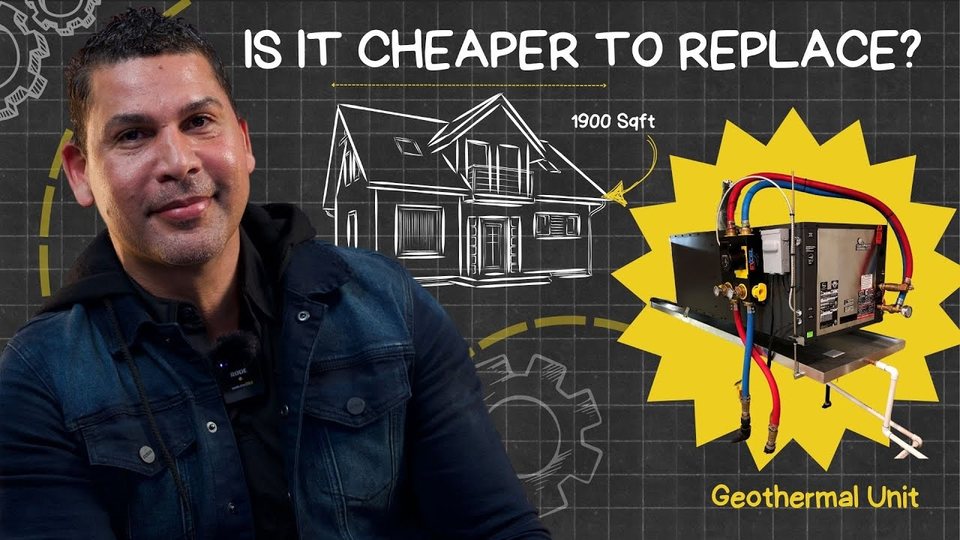
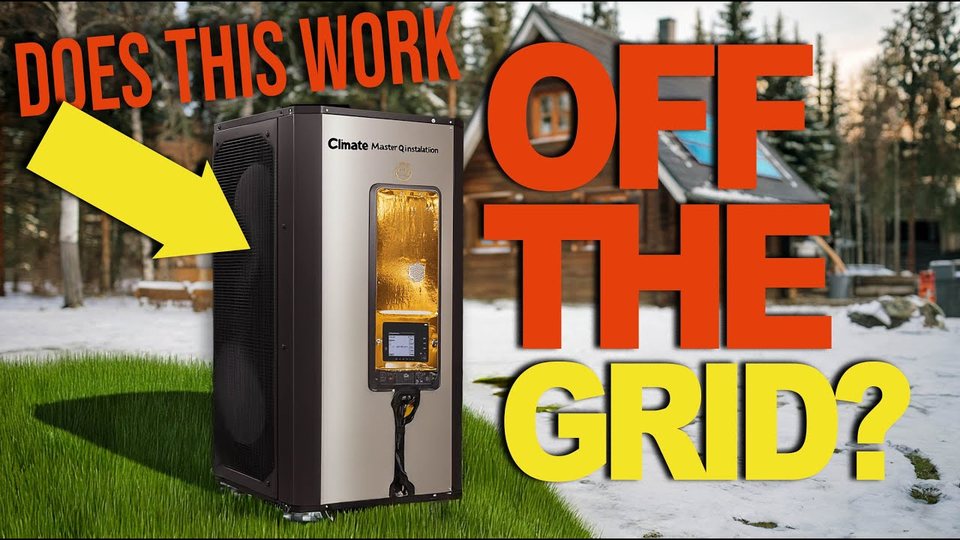
Want to know more about geothermal? Learn from the industry leader himself on the Excel Geothermal Podcast. Hosted by Roy Schar and his daughter Alex, they answer the questions DFW homeowners actually ask — costs, land, loops, and whether geothermal makes sense for your home.


Three simple principles
Constant ground temperature
While outdoor temperatures in DFW swing from 20°F to 110°F, the ground just a few feet below the surface stays a steady 67–69°F. This is free thermal energy waiting to be used.
Underground loop system
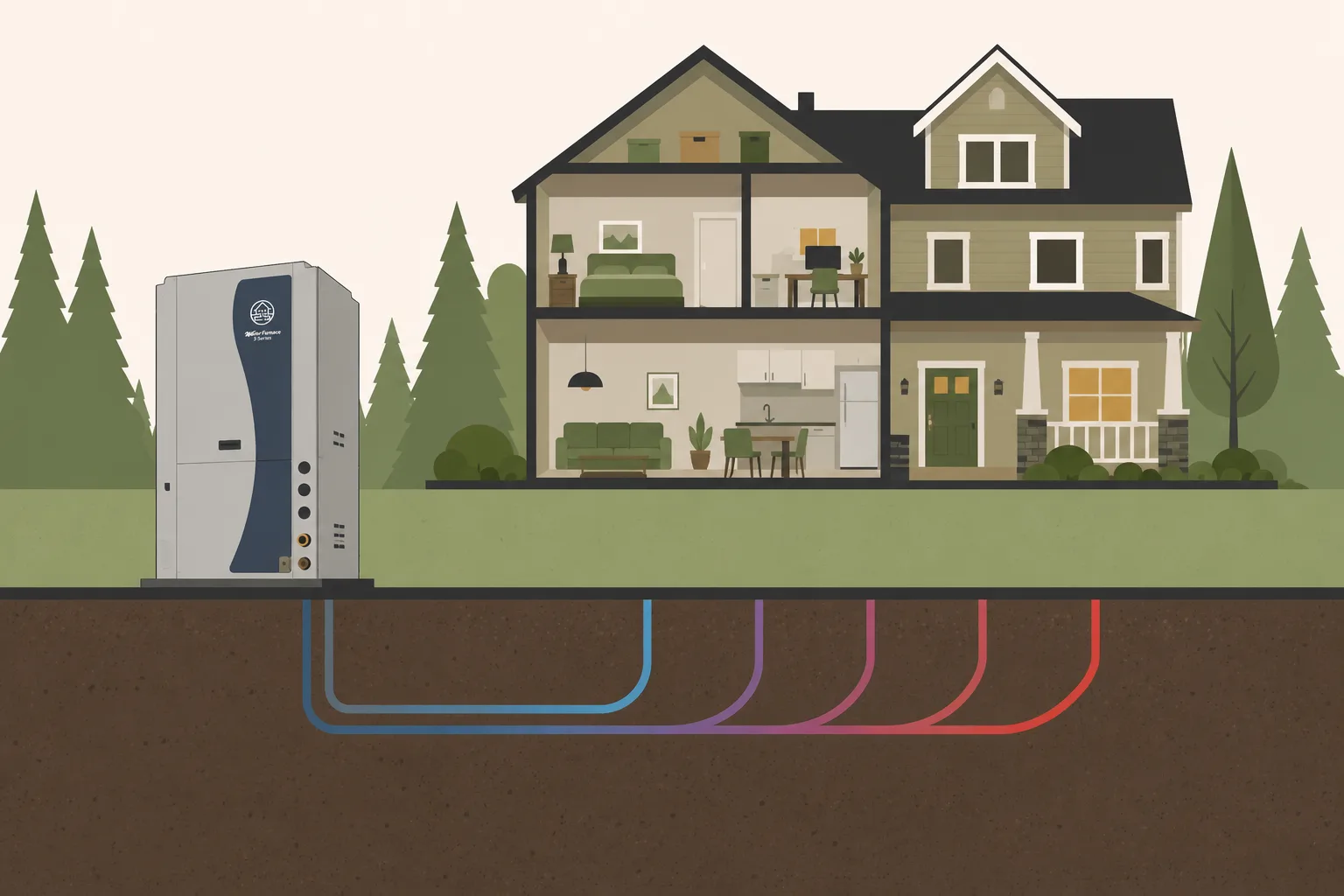
A closed loop of pipe is buried underground (vertical bores or horizontal trenches) filled with a water-based solution. This loop exchanges heat between your home and the earth.
Heat pump does the rest
An indoor heat pump concentrates and distributes the energy. In winter, it extracts heat from the ground. In summer, it removes heat from your home and deposits it underground. No combustion, no outdoor unit.
Your yard works like a cave
Walk into a cave in January and it feels warm. Walk into the same cave in August and it feels cool. The cave never changed — it sits deep enough in the earth that the weather can't reach it.
The dirt under your own yard does the exact same thing. About 20 to 30 feet down, North Texas ground holds steady at 67–69°F every day of the year.
A geothermal system is just a way to plug your house into that cave-like steadiness. Pipes buried in the ground carry water down to where it's always 67°F, then bring that mild temperature back to a heat pump inside your home.
No burning gas. No fighting 105°F air with an outdoor condenser. Just moving heat between your house and a huge, steady thermal battery — the earth itself.
67–69°F below your yard, year-roundTwo thermometers, one yard
One unit in. Four units out.
A geothermal heat pump moves heat instead of making it — delivering up to four units of heating and cooling for every one unit of electricity it uses. The other three come free from the ground, so you pay for just a quarter of the energy and your bill drops to match.
Figures are illustrative. Actual savings depend on your home's size, insulation, climate, energy rates, and usage — the 75% shown is an example, not a guarantee.
Two ways to bury the loop
Which one fits your property comes down to yard space. Both end up in the same steady 67°F earth.
Vertical wells — the DFW favorite
We drill a few wells 200–400 ft straight down, drop in U-shaped pipe, and grout them sealed. A whole well field fits in a side yard — perfect for typical Plano, Frisco, and Richardson lots.
Excel drills with our own rigs and crews — the same rigs that bored 22,000+ ft of wells on a single commercial project.
See the drilling processHorizontal trenches — for big lots
On acreage — think Lucas, Prosper, or Celina — we can dig trenches 4–6 ft deep and lay long runs of looped pipe instead of drilling. More yard disturbed, less drilling, same result.
Either way, the loop is one-time infrastructure. Grass grows back in weeks; the pipe keeps working for 50+ years.
What a full install includesHow long does it all last?
The buried loop has no moving parts — it's the same high-density plastic pipe used in city gas lines, designed to last 50+ years. The indoor heat pump runs 20–25 years, sheltered from sun, hail, and ice.
Compare that to a conventional AC condenser sitting outside through 105°F summers: most are done in 12–15 years.
Typical service life. The loop often outlives the house's second and third HVAC systems.
Myth vs fact
Myth: "Geothermal means hot springs or volcanoes."
Fact: home geothermal just uses the steady 67°F soil under any DFW yard. No special geology needed — clay works great.
Myth: "The pipes will leak and ruin my yard."
Fact: loops are fused (melted together), not glued or clamped, then pressure-tested. There are no fittings underground to fail.
Myth: "It can't keep up in a Texas summer."
Fact: summer is where geothermal shines most — it dumps heat into 67°F earth while conventional AC fights 105°F air.
Five words you'll hear us say
Ground loop
The buried circuit of pipe that trades heat with the earth. The "battery cable" of the whole system.
Bore (or well)
One drilled hole, 200–400 ft deep, holding a U-shaped run of loop pipe. A home usually needs 3–6.
Grout
The sealing mix pumped around the pipe in each well. It locks the pipe to the earth so heat transfers well and groundwater stays protected.
Heat pump
The indoor unit that concentrates heat and pushes it whichever direction you need — into the house in January, out of it in July.
COP
Coefficient of performance — units of heat moved per unit of electricity used. Geothermal runs a COP of 4–5, i.e. 400–500% efficient.
Bonus: heat exchanger
Any place two flows swap heat without mixing — like loop water warming refrigerant inside the heat pump.
Quick answers before you dig deeper
Want the full list? Our FAQ page answers 20+ questions about geothermal in North Texas.
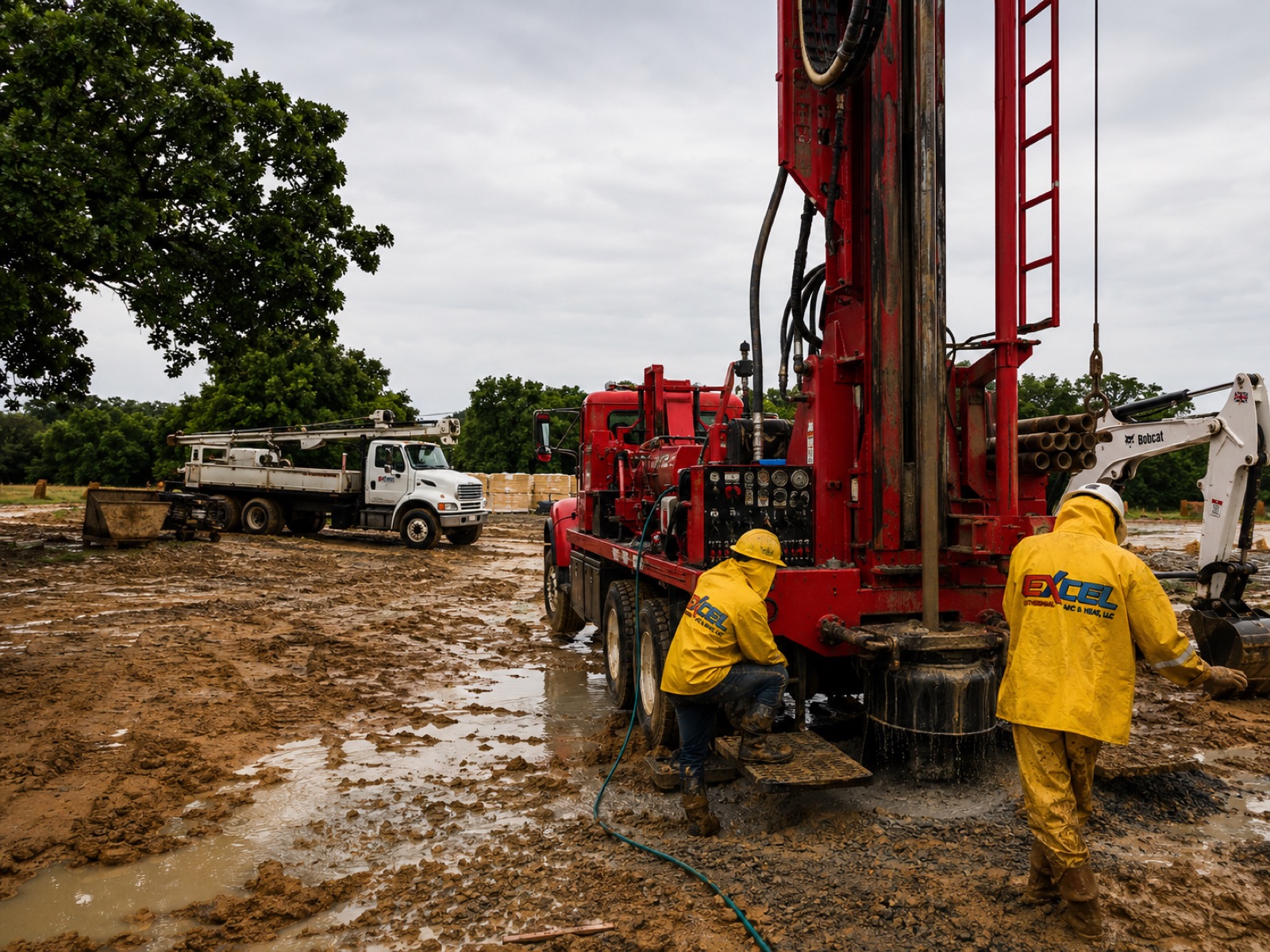
Most DFW homes use vertical wells 200–400 ft deep. North Texas clay and limestone conduct heat well, and we drill with our own rigs — no subcontractors — so wells are placed and grouted to our own standard. Once drilled, they're permanent, one-time infrastructure.
Yes — one system does both. In winter the loop pulls heat from the 67–69°F ground into your home. In summer the flow reverses and your home's heat goes down into the earth. No separate furnace, no outdoor condenser.
The buried loop has no moving parts and is designed to last 50+ years. The indoor heat pump typically runs 20–25 years — roughly double a conventional AC and furnace.
Most complete residential systems run $25,000–$65,000 depending on home size, loop type, and drilling depth. The 50–80% lower operating cost works toward paying that back monthly — see the cost guide and savings calculator.
Yes — that's the point. The ground stays 67–69°F whether the air is 105°F or below zero. During Winter Storm Uri in 2021, Excel's geothermal customers stayed warm while conventional systems across DFW failed. Read the comparison.
Go deeper on any topic
What it costs in DFW
Honest pricing, what drives it up or down, and total cost vs conventional over 20 years.
Read the cost guideSavings calculator
Plug in your square footage and current bill — see your estimated savings and payback.
Run your numbersGeothermal vs conventional
The full head-to-head — efficiency, lifespan, noise, and the Winter Storm Uri test.
See the comparisonAll the questions
20+ answers on cost, installation, performance, and maintenance in North Texas.
Browse the FAQReady for the real thing?
See what a full Excel installation includes — drilling, equipment, ducts, and spray foam, all in-house.
Geothermal installation