
How much could your DFW home save with geothermal?
Move three sliders. Get honest numbers — annual savings, payback, and the 20-year total. No email required, no inflated assumptions, and no tax credit that doesn't exist.
Your home, in three sliders
Tip: the bigger your bill is for your square footage, the faster geothermal pays off. Leaky, hard-working homes benefit most.
Your estimate
$0
saved per year (year one)
0 yrs
simple payback
$0
20-year utility savings
These are estimates, not a quote. Real savings depend on insulation, ductwork, usage, and your electric plan. We assume rates rise 3% per year — DFW rates have actually risen faster than that since 2020.
Get a personalized estimateHow we calculate it — with your numbers
Most calculators hide the formula so they can flatter you. Ours updates live as you move the sliders, so you can check every step.
Start with your electric bill
$300/month × 12 = $3,600 a year.
Take the heating & cooling share
In DFW, air conditioning and heat are roughly 50–60% of the bill. We use 55%: $1,980 a year goes to comfort.
Apply geothermal's cut
Geothermal trims that 50–80%. Based on your system's age, we used 55% — saving $1,089 in year one.
Find the true investment
System for your size: $35,000. Minus the $8,600 conventional replacement you'd buy soon anyway = $26,400 really at stake.
Let rates do their thing
Savings grow ~3% a year as electricity gets pricier. Result: payback in about —, and — of utility savings over 20 years.
Why the ground wins
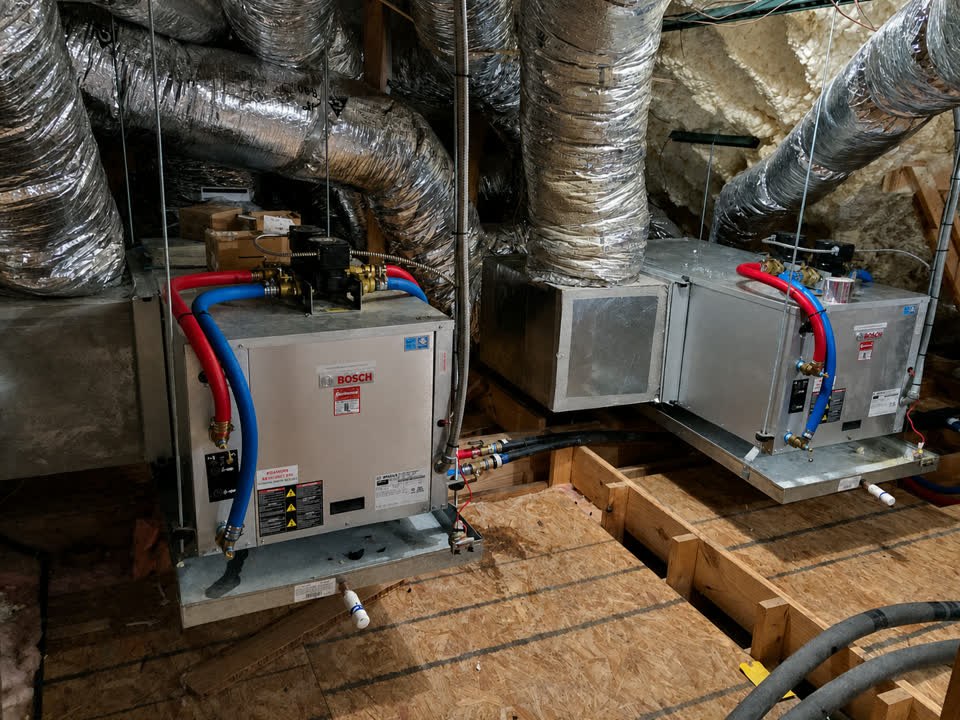
Your loop trades heat with earth that stays 67–69°F all year — like a cave, it ignores the weather. That's why a geothermal unit runs at a COP of 4–5 (400–500% efficient) while a 105°F August afternoon beats a rooftop condenser to death.
What this calculator won't do
It won't add a tax credit. The 30% federal residential credit ended in 2025. Calculators that still include it are lying to you by about a third of the system price.
It won't hide long paybacks. An efficient home with a small bill may see a 15-year payback — and we'll show you that. The loop lasts 50+ years, so the math still works, but you deserve the real curve, not the brochure version.
It won't replace a load calculation. A real quote starts with a Manual J calculation at your home — free, and usually within a day or two of your call.
Who pays back fastest in DFW?
- Big bills, average homes — a Rockwall two-story paying $500+/month is a 7–10 year candidate.
- Systems on their last legs — if a $10K–$15K conventional replacement is coming anyway, geothermal's true premium shrinks fast.
- All-electric homes — no gas bill to offset means every saved kilowatt-hour counts.
- Long-haul owners — the loop under a Lucas or Prosper acreage home will still be working when the kids inherit it.
Every ERCOT rate hike moves these numbers in geothermal's favor — a fixed loop in the ground doesn't care what the grid charges.
About these numbers
It's an honest ballpark. We assume heating and cooling are ~55% of your bill, geothermal cuts that 50–80%, and rates rise 3% a year. Insulation, ductwork, and your electric plan move the real number — which is why the free site visit exists.
Conventional units lose about 2% efficiency per year after year 10, so an old system wastes more power. It also means a conventional replacement bill is coming soon regardless — we subtract that from geothermal's cost, because that's the fair comparison.
A high bill for the square footage. Try it: drop the size slider and raise the bill slider and watch the payback fall. Homes working hardest against Texas summers have the most to save.
No, because it no longer exists for homeowners — it ended in 2025. Commercial projects still qualify for federal incentives through 2035; see our commercial geothermal page.
Put your estimate in context
What it costs in DFW
$25K–$65K installed — see exactly where every dollar goes.
See real pricingAll the questions
Straight answers on cost, installation, performance, and maintenance in North Texas.
Browse the FAQGeothermal vs conventional
Side-by-side on efficiency, lifespan, comfort, and grid resilience.
Compare systems